

In today’s fast-changing professional world, higher education needs to be flexible, practical, and career-focused. Many learners want to continue their studies, but stepping away from work, relocating to another city, or pausing personal responsibilities is not always possible.
This is where Work-Integrated Learning Programmes offer a strong alternative. These degrees allow learners to continue their academic journey while gaining workplace exposure and practical experience. Instead of separating education from employment, this model brings both together.
Students can apply classroom learning in real work environments, build professional skills, and earn a recognised qualification at the same time. Universities such as Deen Dayal Upadhyaya Gorakhpur University and other institutions are offering work-integrated programs across business, commerce, humanities, social sciences, education, and mathematics.
For learners who want to study while working, this format provides a future-ready pathway to academic growth and career advancement.
Table of Contents
What Are Work-Integrated Learning Programmes?
Work-Integrated Learning Programmes combine academic study with practical workplace exposure. They are designed for students, early-career professionals, and working learners who want to continue their education without disconnecting from real-world experience.
This approach helps learners understand concepts better because they are able to connect theory with actual workplace situations. Whether it is business management, finance, literature, politics, economics, education, sociology, or mathematics, the learning becomes more relevant when applied in practical contexts.
Overall Benefits of Work-Integrated Programs
-
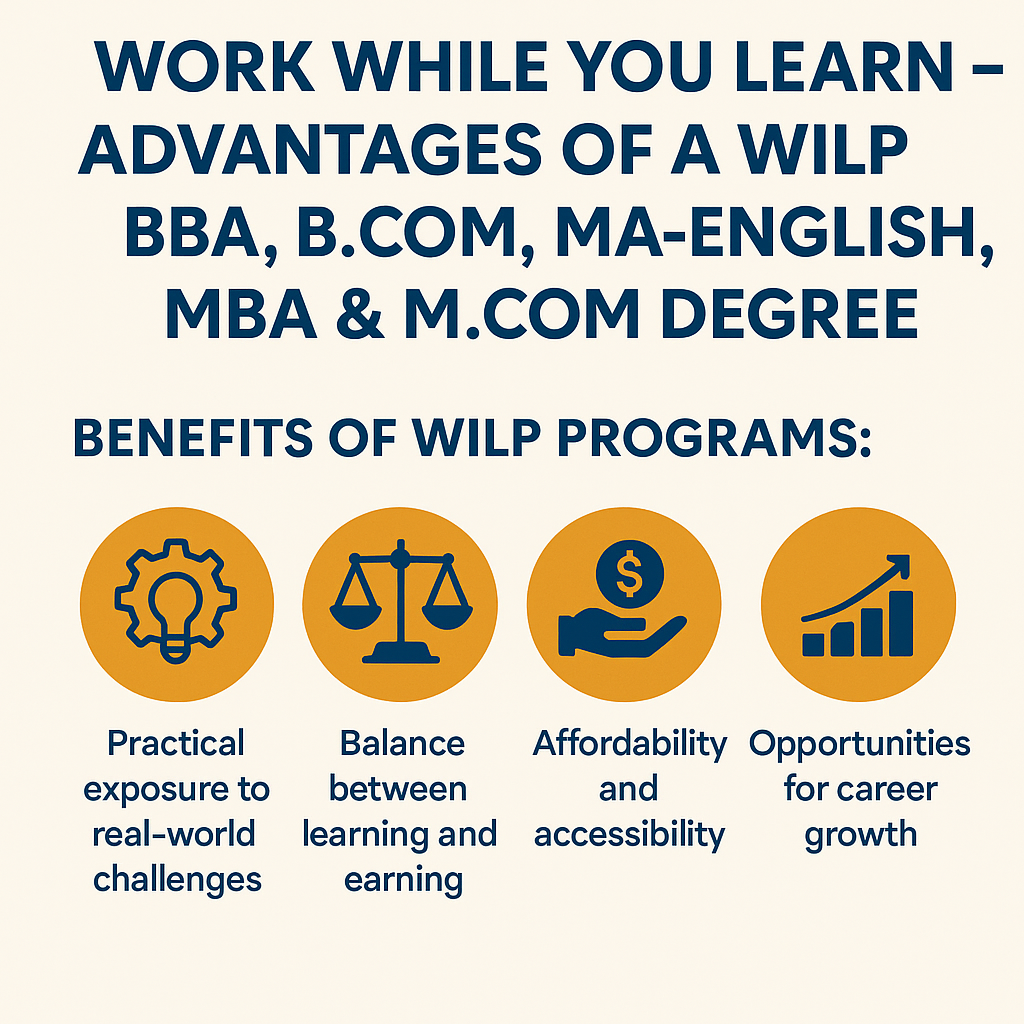
Practical Exposure to Real-World Challenges
Learners do not only study concepts in theory. They also understand how these concepts are applied in workplace settings. This improves problem-solving ability, confidence, and job readiness.
-
Balance Between Learning and Earning
Many students and professionals hesitate to pursue higher education because of financial pressure. A work-integrated format allows them to continue earning while studying, making education more sustainable.
-
Affordability and Accessibility
Traditional full-time degrees may involve relocation, accommodation, and other expenses. This format can be more accessible for learners across different cities and regions.
-
Career Growth Opportunities
By combining academic learning with work exposure, learners can strengthen their resumes and prepare for better roles. The model is especially useful for those who want to grow without taking a career break.
-
Stronger Employability
Employers value candidates who have both academic knowledge and practical exposure. This format helps learners build job-relevant skills while completing their degree.
Programme Highlights
Work-integrated degrees are designed to blend academic learning with practical application. They help learners build subject knowledge, workplace confidence, communication skills, analytical thinking, and career readiness.
| Program | Best Suited For | Key Learning Areas | Skills Developed | Career Opportunities |
|---|---|---|---|---|
| BBA | Learners interested in business, management, entrepreneurship, sales, marketing, HR, or operations | Management principles, marketing, business communication, HR, finance, entrepreneurship, operations | Leadership, communication, decision-making, teamwork, business planning, problem-solving | Business Development Executive, Marketing Associate, HR Executive, Operations Trainee, Sales Executive, Management Trainee, Entrepreneur |
| B.Com | Learners interested in accounts, finance, taxation, banking, commerce, or corporate roles | Financial accounting, business economics, taxation, auditing, business law, corporate accounting | Accounting, financial analysis, data interpretation, tax basics, business reporting, compliance understanding | Accountant, Accounts Executive, Tax Assistant, Banking Associate, Audit Assistant, Finance Executive |
| MA English | Learners interested in literature, writing, communication, teaching, content, publishing, or media | English literature, literary criticism, linguistics, research methodology, communication studies | Analytical reading, academic writing, research, communication, editing, critical thinking | Teacher, Lecturer, Content Writer, Editor, Journalist, Communication Specialist, Research Assistant |
| MBA | Working professionals and graduates aiming for leadership, management, business strategy, or entrepreneurship | Marketing, finance, HR, operations, business strategy, entrepreneurship, organisational behaviour | Leadership, strategic thinking, team management, decision-making, business planning, innovation | Manager, Business Development Manager, HR Manager, Operations Manager, Marketing Manager, Strategy Consultant, Entrepreneur |
| M.Com | Learners interested in advanced commerce, finance, taxation, accounting, audit, research, or academics | Advanced accounting, corporate finance, taxation, business laws, investment management, research methodology | Financial analysis, accounting expertise, tax planning, research, business analysis, and compliance knowledge | Financial Analyst, Accountant, Tax Consultant, Auditor, Corporate Consultant, Research Associate, Assistant Professor |
| MA Political Science | Learners interested in politics, governance, public policy, civil services, law, journalism, or public administration | Political theory, Indian politics, international relations, public administration, Constitution, public policy | Policy analysis, research, critical thinking, political awareness, analytical writing | Policy Research Assistant, Political Analyst, Civil Services Aspirant, Journalist, Academic Researcher, NGO Programme Associate |
| MSc Mathematics | Learners interested in mathematics, analytics, teaching, research, finance, data science, or quantitative roles | Algebra, real analysis, complex analysis, differential equations, statistics, operations research, mathematical modelling | Logical reasoning, quantitative analysis, problem-solving, data interpretation, analytical modelling | Mathematics Teacher, Lecturer, Data Analyst, Research Assistant, Quantitative Analyst, Statistician, Operations Research Analyst |
| MA Sociology | Learners interested in society, social change, development, NGOs, research, education, or policy work | Sociological theory, Indian society, social change, gender studies, social research methods, development studies | Social research, critical thinking, community understanding, qualitative analysis, report writing | Social Researcher, NGO Programme Coordinator, Community Development Officer, Policy Research Assistant, Teacher, Social Worker |
| MA Economics | Learners interested in markets, finance, policy, banking, research, analytics, or economic development | Microeconomics, macroeconomics, Indian economy, development economics, econometrics, public finance, international economics | Economic analysis, data interpretation, research, statistical thinking, market analysis, decision-making | Economic Analyst, Research Associate, Data Analyst, Policy Research Assistant, Banking Associate, Financial Analyst |
| MA Education | Teachers, academic professionals, trainers, education counsellors, and learners interested in education leadership | Philosophy of education, learning psychology, curriculum development, educational technology, assessment, education policy | Teaching, training, curriculum planning, academic leadership, research, counselling, communication | Teacher, Academic Coordinator, Curriculum Developer, Education Counsellor, School Administrator, Research Associate, Training Coordinator |
Who Should Choose These Programs?
These work-integrated degrees are suitable for:
- Students who want to study while gaining practical exposure
- Working professionals who do not want to take a career break
- Learners who want affordable and flexible higher education
- Graduates looking for career growth or academic advancement
- Professionals aiming for promotion or role change
- Learners from smaller towns and cities who want accessible degree options
- Candidates interested in business, commerce, humanities, education, social sciences, or mathematics
Conclusion
Work-Integrated Learning Programmes are reshaping the way students and professionals approach higher education. They allow learners to study, work, and grow at the same time, making education more practical and accessible.
Whether a learner chooses business, commerce, English, management, finance, political science, mathematics, sociology, economics, or education, this format helps build academic knowledge along with real-world experience.
For ambitious students and working professionals in India, these degrees offer a flexible pathway to career advancement, skill development, and lifelong learning. They are especially useful for those who want recognised qualifications without putting their current responsibilities on hold.