

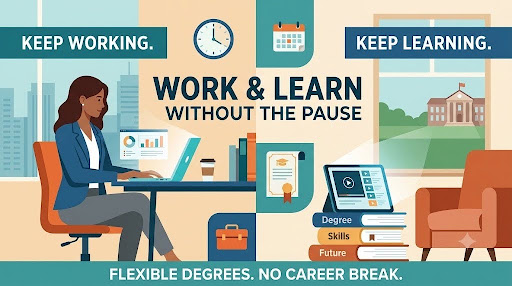
India's workforce is going through a quiet but permanent shift. Layoffs, automation, and rapid role redefinition have made one thing clear: a single degree earned in one's early twenties no longer guarantees long-term relevance. Professionals across banking, IT, retail, education, and public service are returning to classrooms not by quitting their jobs, but by rearranging how education fits into an already full life. Flexible-format universities, once seen as a backup option, have become a mainstream academic pathway for exactly this reason.
This shift raises a practical question for anyone standing at the crossroads of a paycheck and a degree.
Table of Contents
- Can You Really Work Full-Time and Study Full-Time?
- What "Studying While Working" Actually Looks Like Today
- Why This Trend Is Accelerating Across India
- The Student's Dilemma: Ambition Versus Income
- What Parents Quietly Worry About
- Career Perspective: Where Working Learners End Up
- A Framework for Choosing the Right Format: The Work-Study Fit Matrix
- Formats That Make This Possible
- Choosing a Program That Actually Fits Your Career Goals
- Benefits of Studying While Employed
- The Road Ahead
- Frequently Asked Questions
Can You Really Work Full-Time and Study Full-Time?
The honest answer: yes, but only if the academic format is built for it. Traditional, campus-based full-time programs were never designed to coexist with a 9-to-6 job the timetables, attendance rules, and in-person assessments simply don't allow it. This is precisely why can I study full time and work full time has become one of the most searched concerns among working professionals considering higher education. The answer lies not in willpower alone, but in choosing a program structure online, distance, or work-integrated that was designed around a working adult's calendar rather than a student's.
What "Studying While Working" Actually Looks Like Today
It no longer means squeezing in a correspondence course on weekends with a stack of printed material. Modern flexible education blends recorded lectures, live weekend sessions, digital assessments, and structured mentorship, allowing a learner to progress through a recognised degree while continuing full-time employment. For many professionals, this has quietly become the default way to upskill rather than the exception.
Why This Trend Is Accelerating Across India
Several forces are converging to make working while learning a mainstream academic choice rather than a compromise:
- Rising cost-of-living pressures make quitting a job for a degree financially risky
- Employers increasingly value applied experience earned alongside formal study
- The National Education Policy's emphasis on multiple entry-exit points has legitimised non-linear academic journeys
- Digital-first universities have matured, offering credible, UGC-recognised alternatives to campus programs
- Career switching mid-life is now common, requiring reskilling without an income gap
Study while working is no longer a fallback for those who "couldn't get into" a regular program; it has become a deliberate strategy for career-focused adults who want a degree and a paycheck at the same time.
The Student's Dilemma: Ambition Versus Income
For a working learner, the real question isn't whether a degree is valuable; it's whether pursuing one will cost them their current job, their savings, or their sanity. This is where format matters more than the subject itself. A learner asking, “Study while you work?” is really asking about scheduling: can lectures be watched at 11 pm after a shift? Can exams be scheduled around office deadlines? Can assignments be submitted from a phone during a commute? Programs engineered for working adults answer yes to all three.
What Parents Quietly Worry About
Parents rarely voice these concerns outright, but they shape every decision behind the scenes: Will this degree be recognised by employers? Is the university accredited? Will studying at home dilute the quality of learning compared to a campus program? Will this affect my child's current job stability? These worries are valid, and they're addressed not through reassurance but through verifiable facts: accreditation status, faculty credentials, industry tie-ups, and placement or career-support structures that a flexible program offers just as a campus one would.
Career Perspective: Where Working Learners End Up
Choosing to study while employed doesn't limit career outcomes it often accelerates them, because the learner is applying new knowledge to a live job simultaneously. Depending on the discipline chosen, career pathways commonly pursued by working learners include:
- Business & Management (MBA/BBA route): Operations Manager, Business Analyst, HR Manager, Marketing Executive, Entrepreneur
- Commerce (B.Com Hons./M.Com route): Financial Analyst, Tax Consultant, Accounts Manager, Audit Associate, Investment Advisor
- Language & Humanities (MA English route): Content Strategist, Corporate Trainer, Editor, Communications Manager, Academic Researcher
- Political Science & Sociology: Public Policy Analyst, Civil Services Aspirant, NGO Programme Manager, Social Researcher
- Mathematics & Economics: Data Analyst, Actuarial Associate, Research Economist, Statistical Consultant
- Education: Academic Coordinator, Curriculum Designer, Educational Counsellor
Each of these roles rewards exactly the kind of applied, real-world learning that working professionals bring to their coursework something a full-time campus student without job experience cannot replicate.
A Framework for Choosing the Right Format: The Work-Study Fit Matrix
Deciding how to combine a job and a degree isn't just about picking any flexible course it's about matching personal circumstances to the right structure. The Work-Study Fit Matrix offers a simple way to evaluate this:
| Your Situation | Best-Fit Format | Why It Works |
|---|---|---|
| Fixed office hours, no travel flexibility | Online programs | Fully asynchronous content, no location dependency |
| Frequent travel or field-based job | Open and distance learning | Self-paced modules, flexible submission windows |
| Want structured, employer-aligned learning | Work-linked/work-integrated programs | Combines coursework with real workplace application |
| Limited digital access or connectivity | Distance learning with printed/offline material | Lower dependency on constant internet access |
| Seeking rapid career transition | Work-linked programs | Built-in industry exposure alongside academics |
This matrix isn't about which format is "better"; it's about which one removes the most friction from an individual's actual daily routine, since the biggest reason working learners drop out isn't the difficulty of the subject, but the mismatch between format and lifestyle.
Formats That Make This Possible
Universities offering flexible higher education typically structure their programs in three distinct ways, each solving a different working-life constraint:
- Online programs delivered entirely through a digital platform, ideal for learners who need complete time and location independence
- Open and distance learning (ODL), a self-paced model with periodic assessments, suited to learners with unpredictable schedules
- Work-linked programs designed around integrating classroom learning directly with on-the-job application, ideal for professionals wanting immediate career relevance
Deen Dayal Upadhyay Gorakhpur University structures its programs across exactly these three formats: online, open and distance learning, and work-linked, giving working learners the choice to pick a structure that matches their professional reality rather than forcing them into one rigid model.
Choosing a Program That Actually Fits Your Career Goals
Not every flexible-format program suits every career direction. A working professional in finance may benefit more from a commerce-focused degree, while someone in a people-facing role might find more value in a management or language-based qualification. Programs commonly pursued through flexible formats include Bachelor of Commerce Hons., BBA, MA English, M.Com, MA Political Science, M.Sc Mathematics, MA Education, MA Economics, and MA Sociology, each opening a distinct career track without requiring a career pause.
Ready to move up without stepping away from your job?
Explore what it takes to pursue an MBA while continuing full-time employment, because can I study MBA while doing job is a question with a genuinely practical answer: Learn about the Work-Integrated MBA programme.
Benefits of Studying While Employed
- No income disruption during the study period
- Immediate application of academic concepts to real work situations
- Stronger resume positioning through simultaneous experience and qualification
- Reduced financial burden compared to quitting a job for a full-time campus program
- Continuous professional network growth alongside academic learning
- Avoids the opportunity cost of lost salary during a multi-year program
- Builds discipline and time-management skills valued by employers
- Allows learners to test new career directions without fully committing until confident
- Keeps existing job benefits (PF, insurance, tenure) intact throughout the study period
The Road Ahead
As hybrid work becomes permanent and career timelines stretch well beyond a single job or industry, the ability to learn without stepping away from employment will stop being a convenience and start being a baseline expectation. Universities that offer genuinely flexible, recognised formats are positioned to become the primary choice for India's working population not an alternate route, but the main road.
Not sure which format or program suits your schedule best? Before deciding, it's worth exploring the best course to study while working based on your current role and long-term goals: Explore Work-Integrated Learning Programs.