
The reality of 2026's labour market tells a different story. Content creation, editorial strategy, communications management, UX writing, educational technology, academic publishing, journalism, civil services, and teaching, all of these fields are experiencing consistent demand for professionals who can read critically, write with precision, interpret complex texts, and construct coherent arguments. These are not soft skills. They are the structural competencies that an MA in English is specifically designed to build, at the postgraduate level, under disciplined academic conditions.
The distance format adds a further dimension that the myth completely ignores: accessibility. Some of the most intellectually serious students pursuing this degree are working professionals, first-generation learners in smaller cities, educators upgrading their qualifications, and career changers who need a structured humanities postgraduate without a campus relocation. For all of these students, the distance format is not a second-best option; it is the only format that makes the qualification genuinely achievable.
⚡ Pattern Insight
A consistent observation across content, publishing, and media hiring: the MA English
graduate who can articulate their critical reading and analytical writing skills in
professional terms, not academic jargon, consistently outperforms general graduates in
roles requiring editorial judgment. The degree builds exactly the capacity these roles
test; the gap is usually in how graduates present what the degree has given them.
Table of Contents
- What Choosing Distance Mode Actually Means for This Degree
- Who Is Pursuing This and What They Are Navigating
- Who Should Pursue This and When to Start
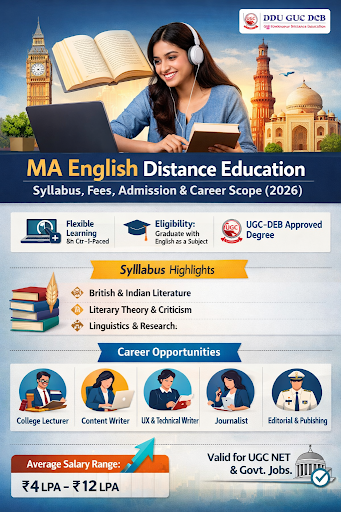
- Syllabus Structure and What Each Component Builds
- Fees, Affordability, and What to Budget For
- Admission Process, What to Expect and How to Prepare
- Career Scope After MA English: Roles, Sectors, and Realistic Pathways
- Where MA English Careers Are Headed: 2026–2030
- Key Takeaways
- Frequently Asked Questions
What Choosing Distance Mode Actually Means for This Degree
MA English Distance Learning is, in its best form, a programme that delivers the full intellectual depth of a postgraduate English curriculum through a flexible, digitally-mediated structure, without requiring the student to choose between their education and the rest of their life. The content is not simplified for distance delivery. The texts are the same, the theoretical frameworks are the same, and the analytical demands of the assessments are the same. What changes is how and when the student engages with that content.
This matters because an MA in English is not a degree where the campus environment is the primary value-driver. Unlike laboratory sciences or clinical programmes, English postgraduate study is fundamentally a reading and writing discipline. The essential activities, close textual analysis, critical argumentation, and independent research, are all things a motivated student can do effectively in a well-designed distance programme. The discussion that happens in a seminar room is valuable, but it is not irreplaceable; and for a student who compensates with independent reading, online academic communities, and self-directed research, the distance mode produces comparable intellectual development.
What the distance format uniquely enables, for this degree specifically, is the integration of study with the literary and professional environment the student is already in. A working journalist studying postcolonial literature at night is reading theory with a professional context that a full-time campus student simply does not have. A teacher studying literary criticism is connecting academic frameworks to the texts they teach daily. This is not a disadvantage of the distance mode. In many cases, it is an advantage that produces more grounded, more applied literary understanding.
🔍 Contrarian Insight
Most students evaluate distance MA programmes based on campus reputation and
fees.
Almost no research the quality of the study materials, the depth of module
notes, the
range of set texts, and the rigour of assessment design. In a distance programme
where
self-directed study is the primary mode, the quality of the study material is
the most
direct determinant of learning quality. This is the research question that
actually
matters.
Who Is Pursuing This and What They Are Navigating
The profile of an MA English distance student is far more varied than the caricature of the recent graduate who could not get into a regular programme. Three types of students consistently appear in this decision space, and each carries a distinct set of pressures and motivations.
The first is the undergraduate English graduate, from a BA English Hons., BA English Literature, or a programme with English as a core subject, who wants to deepen their academic foundation before entering the job market or pursuing a teaching career. For this student, the two years of postgraduate study represent both a knowledge investment and a credential investment. The degree qualifies them for UGC NET, opens teaching positions at the undergraduate level, and signals academic seriousness to employers in content, publishing, and communications.
The second is the working professional in a language or communications-adjacent role, a journalist, a copywriter, a content strategist, a teacher, a translator, who needs the postgraduate qualification either for career advancement or for formal eligibility in roles that require it. For this student, the distance format is not a preference. It is the only viable option, because pausing a career to study full-time carries an opportunity cost that most cannot absorb.
The third profile is the government employee or educator who needs a master's qualification for departmental promotion, salary revision, or regulatory eligibility, most commonly teachers who completed their B.Ed. without a postgraduate degree, or those in state government roles where a master's is now a mandatory advancement criterion. For this group, the decision is not discretionary. It is structurally required, and the distance mode is the only format that allows them to meet the requirement without abandoning the career they are advancing within.
💬 Career Translation
The challenge most MA English graduates face in professional settings is not
that the
degree is weak; it is that they cannot translate what they studied into the
language
employers use. 'I studied Foucault's discourse theory' lands differently than 'I
can
analyse how institutions construct meaning through language and apply that to
communication strategy.' The degree builds the capacity; the professional
framing is
what activates it in a hiring conversation.
Who Should Pursue This and When to Start
Profiles most likely to benefit from this programme:
- BA English graduates targeting NET/SET qualification for college lectureship, the MA is the mandatory prerequisite, and the distance mode allows concurrent exam preparation.
- Working professionals in writing, editing, content, journalism, or communications who need a postgraduate qualification for senior roles or for credibility with institutional employers.
- Teachers in primary or secondary schools are pursuing qualification upgrades, whether for salary revision, promotion eligibility, or transition to higher secondary or college-level teaching.
- Civil services aspirants who want a postgraduate qualification alongside their preparation, the analytical writing and critical reading developed in an MA in English is directly relevant to essay and general studies papers.
- Professionals considering a pivot into academic publishing, educational technology content, or UX writing who want a formal humanities postgraduate foundation to support that transition.
Who should carefully evaluate before enrolling:
- Those who expect the degree alone, without concurrent skill development in writing, editing, or communications tools, to produce immediate high-value employment. The MA builds intellectual capital; translating that into professional capital requires additional, deliberate positioning.
- Students who are genuinely undecided about whether they want an academic or professional career path and who have not yet explored either seriously. An MA in English opens both routes, but the choice of electives, dissertation topic, and co-curricular investment should be guided by a direction, not made in the absence of one.
On timing:
The most common form of regret among MA English graduates is not having started sooner. The degree is most powerful when it arrives before a career plateau rather than after one. For those planning to sit UGC NET, the two years of the programme are also the ideal preparation window, and the academic calendar aligns with it. For working professionals, starting while the subject is still fresh, within two to three years of undergraduate completion, typically produces stronger academic engagement than returning to formal literary study after a decade away.
⚠️ Decision Insight
The question 'what will I do with an MA in English' is asked by almost every
student
at some point. The more precise question is: what do I want to build
professionally,
and does the MA give me the analytical, communicative, and credentialing
foundation to
build it? For a significant range of careers, including teaching, writing,
research,
communications, civil services, and editorial, the answer is yes. The careers
that the
degree does not serve are also real. Clarity about direction is what makes the
difference.
Syllabus Structure and What Each Component Builds
The MA English syllabus for distance education follows a four-semester structure that moves progressively from literary history and foundational theory in the first year to specialised thematic, cultural, and research-oriented study in the second. The specific paper titles vary by institution, but the broad curricular architecture is consistent across recognised programmes.
| Semester | Core Papers and Study Areas |
|---|---|
| Semester I | British Literature: Renaissance to 18th Century | Literary Criticism and Theory (Classical to Romantic) | Indian Writing in English | Linguistics: Phonology and Syntax | Communication Skills and Academic Writing |
| Semester II | British Literature: Romantic to Victorian | Modern Literary Theory (Structuralism, Marxism, Feminism) | American Literature | Stylistics and Discourse Analysis | Research Methodology for Literary Studies |
| Semester III | Postcolonial Literature and Theory | Postmodern and Contemporary Fiction | World Literature in English | Cultural Studies and Media Theory | Elective: Drama / Poetry / Women's Writing |
| Semester IV | Literary Theory: Psychoanalysis, New Historicism, Ecocriticism | Comparative Literature | Dissertation / Research Project | Elective: Translation Studies / Dalit Writing / Digital Humanities | Seminar: Contemporary Critical Debates |
What the curriculum actually develops, in professional terms:
| Study Area | Professional Capability Built |
|---|---|
| Literary Theory and Criticism | Ability to analyse how texts construct meaning, power, and identity, directly applicable in communications, media analysis, and content strategy |
| Linguistics: Phonology, Syntax, Discourse | Structural understanding of language is useful in language teaching, editorial roles, UX writing, and linguistic research |
| Research Methodology | Skills in literature review, academic argument construction, citation, and independent inquiry are foundational for PhD study and analytical roles |
| Postcolonial and World Literature | Critical frameworks for reading cultural difference, representation, and power are valuable in international organisations, journalism, and policy writing |
| Cultural Studies and Media Theory | Analytical tools for understanding media, popular culture, and ideological representation, relevant for journalism, communications, and content roles |
| Academic Writing and Communication | High-level written argumentation and professional communication are the most directly transferable competencies across virtually all English-medium careers |
| Dissertation / Research Project | Independent sustained research, original critical argument, and long-form writing, the strongest single demonstration of postgraduate capability |
The dissertation in Semester IV is the programme's most consequential component, and the most underestimated. Students who treat the dissertation as an obligation to be discharged are missing the only component of the degree where they produce original, attributed academic work. This is the document that can be cited in job applications, used as a writing sample for publishing or editorial roles, and developed into conference papers or publications for those pursuing academic careers. The dissertation is worth treating as a professional artefact from the moment the topic is chosen.
📚 Choosing Your Dissertation Topic Wisely
In a distance MA, the dissertation is your primary point of differentiation.
Choose a
topic that sits at the intersection of your genuine intellectual interest and
the career
you are building toward. A dissertation on digital storytelling and narrative
theory is
more useful to an EdTech content professional than one on Victorian prosody,
even if
both are academically valid. Your supervisor cannot read your career intentions.
You
have to bring that direction to the topic choice.
Career Scope After MA English: Roles, Sectors, and Realistic Pathways
The career scope of an MA English course is consistently wider than most students and parents appreciate at the point of admission, and it has expanded meaningfully in the past three years as content, communications, and EdTech sectors have grown. The degree opens pathways across six distinct professional domains, each with its own role architecture and salary trajectory.
| Career Path | Sectors / Employers | Avg. Salary Range (India) |
|---|---|---|
| College Lecturer / Assistant Professor | Degree colleges, universities (requires NET/SET) | Rs. 5 – 10 LPA (UGC scale) |
| Senior School English Teacher | CBSE/ICSE/State board schools (PGT level) | Rs. 4 – 8 LPA |
| Content Writer / Senior Copywriter | Digital agencies, brands, SaaS, e-commerce | Rs. 4 – 9 LPA |
| Editorial Assistant / Copy Editor | Publishing houses, academic journals, media firms | Rs. 3.5 – 7 LPA |
| Journalist / Feature Writer | Print, digital, broadcast media | Rs. 4 – 8 LPA |
| UX Writer / Technical Writer | Product companies, SaaS, tech firms | Rs. 6 – 12 LPA |
| Communications Executive / Manager | Corporations, PR agencies, NGOs, GCCs | Rs. 5 – 11 LPA |
| Civil Services (IAS/IPS/IFS) | UPSC, Optional English paper advantage | Government pay scale |
| Academic Researcher / PhD. Scholar | Universities, research institutions (JRF) | Rs. 3.1 – 5 LPA (fellowship) |
| Content Strategist / EdTech Writer | EdTech platforms, online learning firms | Rs. 5 – 10 LPA |
Two pathways in this table deserve particular attention for 2026 graduates. The UX writing and technical writing pathway consistently commands the highest salary ceiling among non-academic roles for MA English graduates, and it is the most underutilised. Product companies and SaaS firms need professionals who can write with clarity, understand user cognition, and structure information for usability. MA English graduates have exactly these foundations; what most lack is awareness that this pathway exists and the deliberate portfolio-building that accessing it requires. The EdTech content pathway is similarly undervalued; platforms building digital learning content for school and undergraduate audiences need writers who understand both subject-matter depth and pedagogical communication. An MA English graduate with even basic familiarity with instructional design principles is a strong candidate for these roles.
making the academic research pathway financially viable as a full-time commitment.Fees, Admission, and What to Expect
The cost of pursuing an MA in English through distance education is significantly lower than on-campus equivalents, making it one of the most accessible postgraduate qualifications in the country. The total fee for a recognised, UGC-DEB-approved distance MA English programme is Rs. 30,500 per year.
Admission Process:
- Registration: Online through the university portal during the admission cycle (typically twice a year).
- Eligibility Check: Submission of undergraduate mark sheets and degree certificates for verification of merit and subject background.
- Fee Payment: Payment of the first-year admission and tuition fees upon confirmation of eligibility.
- Enrolment: Issuance of an enrolment number and access to the student portal and study materials.
Where MA English Careers Are Headed: 2026–2030
- India's higher education expansion under NEP 2020 is creating new college and university positions, particularly in newly established institutions, generating sustained demand for NET-qualified English faculty across tier-2 and tier-3 cities where the existing faculty pipeline is thinnest.
- The EdTech sector continues to invest in high-quality academic content development. The demand for writers who can produce curriculum-grade English content, at secondary, undergraduate, and competitive examination levels, is structural and growing.
- Global Capability Centres expanding in India are creating communications, documentation, and editorial roles that require strong written English and critical reading skills at the professional level.
- The international publishing market, academic journals, trade publishers, and literary magazines are increasingly engaging Indian editorial talent for offshore roles.
- Civil services as a career pathway continues to attract MA English graduates because of the direct alignment between the degree's analytical and writing demands and the UPSC examination requirements.
🔭 Future Projection
By 2027–28, AI content generation tools will have automated a significant
portion of
routine copywriting and templated content production. The MA English graduate
who
positions themselves in editorial judgment, strategic content architecture, or
creative
long-form writing, roles where quality of thought and cultural literacy matter,
will be
in a fundamentally more secure professional position than those competing in
volume-based
content production.
MA English at a Glance
| Programme | Master of Arts, English Literature and Language |
| Mode | Distance / Correspondence, no mandatory campus attendance |
| Duration | 2 Years (4 Semesters) | Some institutions allow up to 5 years |
| Eligibility | Bachelor's degree with English as a main/subsidiary subject from a recognised university |
| Core Focus | Literary Theory, British & Indian Literature, Linguistics, Research, Cultural Studies |
| Career Pathways | Teaching, Content, Publishing, Journalism, Civil Services, Communications, Research |
| Recognised By | UGC-DEB-approved programmes carry full statutory equivalence with on-campus degrees |
Key Takeaways
- An MA in English in distance mode is a full, UGC-recognised postgraduate degree, not a shortcut. Where issued by a DEB-approved institution, it carries the same statutory validity as an on-campus master's for employment and NET eligibility.
- The syllabus builds capabilities that are increasingly valuable in 2026's labour market; critical reading, analytical writing, and cultural literacy are the hard skills of the knowledge economy.
- Career scope extends far beyond teaching, encompassing UX writing, EdTech content, communications management, editorial, and civil services.
- The distance format is the right format for most people pursuing this degree, removing geographical and scheduling barriers without compromising learning quality.
- Start earlier, not later; the window where the MA is most powerful is the first five years after undergraduate completion.