
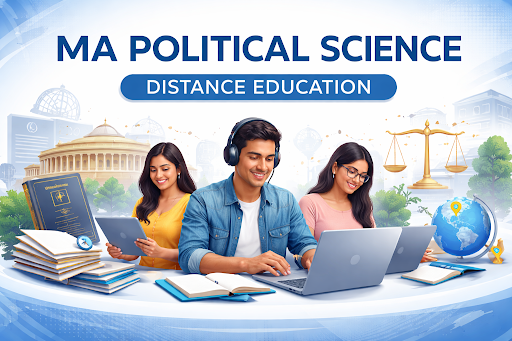
And yet, the MA in Political Science is consistently underestimated as a postgraduate qualification. It is often seen as the degree you pursue if you plan to sit competitive examinations and need something to do while preparing. This misreads both what the degree builds and what the market for politically literate professionals actually looks like in 2026.
India's expanding policy infrastructure, think tanks, development organisations, international aid agencies, state government planning departments, legislative research services, and public affairs consultancies, is generating consistent demand for professionals who can read political systems analytically, interpret policy implications, write persuasively for public audiences, and understand the relationship between institutional design and social outcomes. These are not soft competencies. They are the hard outputs of a rigorous postgraduate programme in political science. And for a significant portion of India's working population, teachers, government employees, social sector professionals, and competitive examination aspirants, the distance format is the only viable path to this credential.
⚡ Pattern Insight
A consistent observation across civil services coaching and policy research hiring:
candidates who have engaged seriously with an MA Political Science curriculum, not just
listed it on their CV, demonstrate measurably stronger analytical writing in UPSC Mains
essay and GS papers, and in written assessments for policy research roles. The degree
does not just signal eligibility. It builds the analytical capacity that these
assessments are testing.
Table of Contents
- What Distance Mode Means for This Particular Degree
- Who Is Making This Decision, and What They Are Carrying
- Who Should Pursue This and What the Decision Hinges On
- Syllabus Structure, What the Programme Covers and What It Builds
- Career Scope After MA Political Science: Roles, Sectors, and Pathways
- Government Jobs After MA Political Science: The Full Landscape
- Fees, Admission, and What to Expect
- Where Political Science Careers Are Headed: 2026–2030
- Key Takeaways
- Frequently Asked Questions
What Distance Mode Means for This Particular Degree
MA Politics Distance Learning is, at its best, a programme that delivers the full intellectual scope of a postgraduate political science curriculum, from classical political philosophy to contemporary international relations theory, through a structured, self-directed format that does not require physical campus attendance. The content is not condensed for the distance format. The texts, the theoretical frameworks, and the analytical demands of the assessments are equivalent to what an on-campus student engages with.
This matters particularly for political science because the discipline's essential activity, reading complex texts critically, constructing evidence-based arguments about political phenomena, and thinking across historical and contemporary cases, is work that a motivated student can do effectively outside a lecture hall. The seminar discussion that happens on campus is valuable, but it is not irreplaceable. A student who compensates through serious independent reading, engagement with current affairs as a live case study of the concepts they are studying, and disciplined writing practice can develop comparable analytical depth through the distance mode.
What the distance format uniquely enables, for political science in particular, is the integration of academic study with the political and institutional environments the student is already embedded in. A government officer studying comparative federalism is reading theory about the system they operate within daily. A journalist studying media and politics is analysing, academically, the environment they cover professionally. A teacher studying political philosophy is building the conceptual depth that makes them a qualitatively different instructor. This layering of study over lived context is not a limitation of the distance mode. It is one of its most productive features.
🔍 Contrarian Insight
Most students and parents evaluating a distance MA in Political Science focus on the
institution name and fee structure. The question that actually determines the
quality of learning, and therefore the value of the degree, is whether the
programme's curriculum has been updated to include contemporary political theory,
comparative democratic backsliding literature, international relations in the
post-2020 order, and digital politics. A distance programme built on a 2008 syllabus
will not prepare a student for the policy and academic environments of 2026,
regardless of the institution's historic reputation.
Who Is Making This Decision, and What They Are Carrying
The profile of someone pursuing an MA in Political Science through distance education is considerably more varied than the default assumption of 'student preparing for civil services.' Three distinct profiles consistently appear in this decision space, each navigating a different version of the same underlying question.
The first is the competitive examination aspirant, someone who is actively preparing for UPSC Civil Services, State PSC examinations, or central government recruitment, and who needs a postgraduate qualification as a formal credential alongside their preparation. For this student, the distance format is logistically essential: examination preparation is a full-time cognitive investment, and attending a campus programme simultaneously is not feasible. The MA from a recognised institution provides the credential floor; the examination preparation builds on top of it. When these two activities are well-aligned, when the student chooses optional and elective papers that reinforce their examination subject choices, the return is significantly higher than treating them as separate parallel tracks.
The second is the working professional in a government, civil society, or social sector role, a junior government officer, an NGO programme coordinator, a panchayat-level functionary, a school teacher, who needs a postgraduate qualification for departmental promotion, salary revision, or regulatory advancement. For this group, the MA is not primarily an intellectual undertaking. It is an institutional requirement. The distance format exists precisely to serve this need without forcing the individual to pause a career that is already established.
The third is the genuinely intellectually motivated student who completed a BA in Political Science or a related social science and wants to pursue the discipline at depth, either toward a career in policy research, academic teaching, or international organisations, but cannot attend a full-time programme due to financial or geographic constraints. For this student, the distance format is a constraint, but it is a workable one. With disciplined engagement, access to a good library or digital resource base, and a well-chosen dissertation topic, the distance MA produces the academic foundation that further study and policy careers require.
💬 Career Translation
One of the most consistent gaps in how MA Political Science graduates present
themselves to policy research employers and international organisations is the
inability to connect their academic work to real-world political analysis. 'I
studied democratic theory' is not a professional statement. 'I analysed the
structural conditions under which democratic backsliding occurs, using three
comparative case studies' is. The degree builds the analytical capacity; the ability
to articulate it in professional language is what converts it into career access.
Who Should Pursue This and What the Decision Hinges On
Profiles most likely to see significant career impact:
- UPSC / State PSC aspirants who want to use the MA curriculum to simultaneously build their General Studies and optional paper foundation, particularly for Political Science and International Relations as optional subjects.
- Government employees and teachers who need a postgraduate qualification for promotion, pay revision, or eligibility for senior administrative or academic roles.
- Professionals in NGOs, development organisations, and think tanks who are operating at analytical and programme levels require a formal social science postgraduate credential for credibility and advancement.
- Graduates planning to sit UGC NET in Political Science, for whom the MA is the mandatory prerequisite for college lectureship eligibility.
- Journalists, public affairs professionals, and policy communicators who want the disciplinary rigour of a postgraduate political science education to sharpen the analytical framework they bring to their work.
Who should think carefully before enrolling:
- Those who plan to pursue the MA passively, as a credential to hold while doing something else entirely, without engaging with the curriculum. In political science, the examination papers reward analytical thinking that cannot be crammed; disengaged study tends to produce graduates who have the credential but not the capability.
- Students who want broad social science exposure rather than political science depth, an MA in Public Administration, Sociology, or a multidisciplinary social science programme may be a better structural fit.
On timing, when does the credential matter most?
For competitive examination aspirants, the ideal is to complete or be well into the MA by the time they appear for their Mains examination, so that the academic rigour of the programme has already sharpened their analytical writing. For working professionals, the earlier the credential is obtained relative to the promotion cycle it is aimed at, the better. The distance format allows rolling or annual admission at most institutions, which means deferral is a choice, not a structural constraint.
⚠️ Decision Insight
The most consequential decision in pursuing an MA in Political Science through
distance mode is not which institution to enrol in. It is how to engage with the
programme once enrolled. Students who treat the degree as a parallel intellectual
commitment, reading beyond the prescribed texts, connecting theoretical frameworks
to current political events, writing analytically rather than descriptively in their
assessments, graduate with a qualitatively different set of capabilities than those
who complete the minimum requirements. The distance format creates this choice more
starkly than an on-campus environment does, because there is no external structure
to carry a disengaged student forward.
Syllabus Structure, What the Programme Covers and What It Builds
A well-designed MA Political Science curriculum is structured across four semesters, moving from foundational political theory and Indian government in the first year to comparative, international, and research-oriented study in the second. The specific paper titles vary by institution, but the broad curricular architecture is consistent across recognised programmes.
| Semester | Core Papers and Study Areas |
|---|---|
| Semester I | Western Political Thought (Classical to Enlightenment) | Indian Political Thought and Traditions | Indian Government and Politics | Introduction to International Relations | Research Methodology in Social Sciences |
| Semester II | Contemporary Political Theory (Postmodernism, Feminism, Green Politics) | Comparative Politics and Government | Indian Foreign Policy | Public Administration: Theory and Practice | Elective: Electoral Politics / Federalism / Constitutional Law |
| Semester III | International Political Economy | South Asian Politics and Relations | Human Rights and International Law | Political Sociology | Elective: Political Communication / Conflict Resolution / Development Politics |
| Semester IV | Global Governance and International Organisations | Security Studies and Strategic Affairs | Digital Politics and Governance | Dissertation / Research Project | Elective: Environmental Politics / Gender and Politics / Diaspora and International Relations |
What each study area builds, translated to professional terms:
| Study Area | Professional Capability Developed |
|---|---|
| Western and Indian Political Thought | Ability to trace the genealogy of political ideas and apply them to contemporary governance debates, essential for UPSC essays and policy analysis writing |
| Comparative Politics | Frameworks for analysing different political systems, electoral models, and governance structures, directly applicable in policy research and journalism |
| International Relations Theory | Theoretical tools for interpreting geopolitical events, alliance systems, and multilateral negotiations, relevant for foreign affairs journalism and international organisation roles |
| Public Administration | Understanding of bureaucratic theory, administrative ethics, and public policy implementation, directly aligned with civil services preparation and government sector roles |
| Research Methodology | Ability to design social science research, conduct literature reviews, and construct evidence-based arguments, foundational for academic careers and policy research positions |
| Digital Politics and Governance | Emerging analytical capacity in platform regulation, algorithmic politics, electoral misinformation, and e-governance, relevant to the most current layer of political practice |
| Dissertation / Research Project | Original sustained inquiry into a political science question, the programme's strongest single demonstration of postgraduate analytical capability |
📋 On Choosing Your Dissertation Topic
In a distance MA, the dissertation is your primary point of intellectual
differentiation. Choose a topic that sits at the intersection of your genuine
interest, your career direction, and the contemporary political landscape. A
dissertation on federalism and fiscal transfers is more directly useful to a civil
services aspirant than one on 19th-century political philosophy, even if both are
academically defensible. Bring your professional context and your career intent to
the topic selection conversation with your supervisor.
Career Scope After MA Political Science: Roles, Sectors, and Pathways
Political Science Career Options for postgraduate degree holders are consistently wider than the standard 'civil services or teaching' binary that dominates most career counselling conversations about this subject. The degree opens pathways across six distinct professional domains, each with its own role architecture, salary range, and advancement logic.
| Career Path | Sectors / Employers | Avg. Salary Range (India) |
|---|---|---|
| IAS / IPS / IFS (Civil Services) | Union and State Government via UPSC | Rs. 56,100+ per month (Grade Pay scale) |
| State PSC / Allied Services | State Governments, SDM/BDO/Block level | Rs. 35,000 – 70,000 per month |
| Assistant Professor (Political Science) | Degree colleges, universities (NET/SET required) | Rs. 5 – 10 LPA (UGC scale) |
| Policy Research Analyst | Think tanks, NITI Aayog affiliates, foundations | Rs. 5 – 10 LPA |
| Legislative Research Assistant | PRS Legislative Research, parliamentary staff | Rs. 5 – 9 LPA |
| Political Journalist / Analyst | Print, digital, broadcast media | Rs. 4 – 9 LPA |
| International Organisation Programme Officer | UN agencies, World Bank, UNDP, INGOs | Rs. 8 – 18 LPA |
| Public Affairs / Government Relations Manager | Corporates, consultancies, industry associations | Rs. 7 – 14 LPA |
| Development Sector Programme Manager | NGOs, CSR wings, bilateral aid agencies | Rs. 5 – 11 LPA |
| Legal / Administrative Officer (Government) | PSUs, government departments, tribunals | Rs. 5 – 9 LPA |
Three pathways in this table consistently receive less attention than they deserve. The legislative research pathway, working with organisations like PRS Legislative Research or parliamentary staffing units, requires exactly the combination of political science knowledge, policy reading capacity, and clear analytical writing that an MA produces. It is a high-credibility, intellectually demanding role that is directly in the discipline's domain, and it is consistently underpopulated relative to the available talent pool. The public affairs and government relations pathway is growing rapidly as large corporates and industry associations build dedicated teams to manage regulatory interface and policy engagement, roles where a postgraduate political science background is the most directly relevant qualification available. The international organisation pathway, while highly competitive, is specifically structured to value postgraduate social science credentials alongside language skills and field experience, making the MA a genuine entry point rather than a marginal one.
The Civil Services Pathway, How the MA Specifically Helps:
The MA Political Science curriculum and the UPSC Civil Services preparation overlap most directly in four areas: the optional subject paper (Political Science and International Relations is one of the highest-scoring optional subjects in UPSC Mains), the GS Paper II (Governance, Constitution, Polity), the Essay paper, and the Personality Test, where analytical clarity and informed views on political and administrative questions are tested directly. Students who use the distance MA as a structured preparation framework, reading academic texts for conceptual depth, writing analytical answers rather than descriptive ones, and engaging with current affairs through the theoretical lenses the programme provides, produce qualitatively stronger UPSC answers than those who prepare from coaching materials alone.
Government Jobs After MA Political Science: The Full Landscape
Understanding the full spectrum of government jobs after an MA in Political Science requires moving beyond the UPSC Civil Services as the default frame of reference. The government employment ecosystem is considerably broader, and an MA in Political Science opens formal access to a significant range of it.
| Government Job Category | Qualifying Examination / Entry Route |
|---|---|
| IAS / IPS / IFS / Central Services | UPSC Civil Services Examination (Prelims + Mains + Interview) |
| Indian Foreign Service (IFS) | UPSC Civil Services requires a strong international relations foundation |
| State Administrative / Revenue Services | State Public Service Commission (PSC) examinations |
| Assistant Section Officer (Central Secretariat) | SSC Combined Graduate Level / UPSC CAPF |
| Intelligence Bureau (IB) Assistant Central Intelligence Officer | IB ACIO Examination, analytical aptitude tested |
| Research and Analysis Wing (RAW), Entry pathways | UPSC Civil Services as the primary route; specialised lateral entry |
| Assistant Professor (Government Colleges) | UGC NET / State SET, MA is a mandatory prerequisite |
| Legislative Assembly / Parliament Secretariat Staff | Secretariat examinations; research assistant roles via direct recruitment |
| UPSC Combined Defence Services (Officers) | CDS Examination, a political science background is useful for GS and SSB |
| District Planning / Administrative Roles (State Government) | State PSC examinations; contract roles via DPPQ / planning departments |
One pathway that is systematically overlooked in career counselling for MA Political Science graduates is the government research and intelligence analyst track. Organisations, including the Cabinet Secretariat, Ministry of External Affairs research divisions, and state intelligence units, recruit analysts with strong political science postgraduate credentials, either through lateral recruitment or through UPSC pathways. These roles are not widely advertised, and they require not just the credentials but demonstrable analytical writing ability, which is precisely what the MA dissertation and research methodology component builds.
🔭 Future Projection
By 2027–28, India's expanding diplomatic footprint, growing multilateral engagement,
and increasing policy complexity are expected to create sustained institutional
demand for postgraduate social science professionals across government ministries,
regulatory bodies, and India's expanding presence in international organisations.
The MA Political Science graduate who combines disciplinary rigour with language
proficiency and demonstrated analytical writing will be entering one of the
strongest hiring environments for this credential in recent years.
Fees, Admission, and What to Expect
Distance MA Political Science programmes from UGC-DEB recognised universities are among the most financially accessible postgraduate qualifications in the social sciences. Annual fees typically range from Rs. 8,000 to Rs. 25,000, depending on whether the institution is a central university, a state university, or a private deemed university with DEB approval. The total two-year cost is therefore broadly between Rs. 16,000 and Rs. 50,000, well within the range of a considered professional investment for most working adults, and a fraction of the cost of full-time campus alternatives.
The admission process at most recognised institutions is merit-based on undergraduate performance, without a competitive entrance examination. Applicants submit their BA marksheets, degree certificates, identity proof, and category documents (if applicable) through an online or offline application process, pay a nominal application fee, and receive confirmation through a merit list or direct admission. Some universities offer rolling admissions; others operate on a fixed annual or biannual cycle, with primary intake in July–August and a supplementary intake in January at select institutions.
The standard eligibility is a bachelor's degree from a recognised university with Political Science or a related social science as a core or subsidiary subject, typically with a minimum aggregate of 45% to 50%. Some institutions accept graduates from any discipline for general social science postgraduate programmes. Applicants should verify specific eligibility requirements with their chosen institution and confirm UGC-DEB approval status before completing the application.
Where Political Science Careers Are Headed: 2026–2030
- India's expanding presence in multilateral forums, G20 chair outcomes, BRICS expansion, and SCO engagement are creating institutional demand for professionals who understand the architecture of international organisations and can work within them. The MA Political Science with strong international relations content is a genuine entry-level credential for junior roles in these spaces.
- The policy research ecosystem in India is growing faster than the talent pipeline; think tanks, state planning departments, and development sector research units are consistently understaffed relative to their analytical workload. MA Political Science graduates with strong writing skills and demonstrated research capacity are consistently in demand in this space.
- Digital politics, platform regulation, algorithmic governance, and electoral disinformation are emerging as a distinct subfield within political science, and the professionals who understand both the political theory and the digital context are a small and growing category. Distance programmes that include this content are preparing graduates for roles that barely existed five years ago.
- Public affairs and government relations as a professional sector is growing as India's regulatory complexity increases. Corporations, international firms, and industry associations are building dedicated government interface teams, and the political science postgraduate who can read the legislative and regulatory environment analytically is the natural candidate for these roles.
- The teaching and academic pathway through UGC NET continues to be a viable and stable career option, particularly as new colleges and universities established under NEP 2020 expand their social science departments and create faculty demand outside metro cities.
Key Takeaways
| MA Political Science at a Glance | |
|---|---|
| Programme | Master of Arts, Political Science |
| Mode | Distance / Correspondence, no mandatory campus attendance |
| Duration | 2 Years (4 Semesters) | Some institutions allow up to 5 years |
| Eligibility | Bachelor's degree with Political Science / Social Sciences from a recognised university |
| Core Focus | Political Theory, Comparative Politics, International Relations, Public Administration, Research |
| Career Pathways | Civil Services, Teaching, Policy, Research, Journalism, International Organisations, Law |
| Recognised By | UGC-DEB-approved programmes carry full statutory equivalence with on-campus degrees |
- An MA in Political Science through distance mode is a full, UGC-recognised postgraduate degree, not a concession to circumstance. Where issued by a DEB-approved institution, it carries the same statutory validity as an on-campus master's for employment, NET eligibility, and civil services qualification purposes.
- The curriculum builds capabilities that are directly relevant to India's expanding policy, governance, and international engagement landscape. Analytical reading, evidence-based argument construction, comparative political analysis, and research methodology are not soft skills. They are the hard outputs of a rigorous political science education.
- Career scope extends well beyond civil services and teaching, policy research, legislative analysis, international organisations, public affairs, journalism, and development sector management are all growing pathways where the MA Political Science is the most directly relevant postgraduate credential available.
- The government employment landscape after MA Political Science is broader than UPSC alone, State PSC roles, government college teaching, legislative research, central secretariat services, and intelligence analyst tracks all formally value this credential.
- How you engage with the programme determines what you get from it, the distance format creates a clear choice between passive credential collection and active intellectual development. The students who use the distance MA as a serious academic commitment, connecting theory to current political events and writing analytically throughout, graduate with a qualitatively different capability set.