
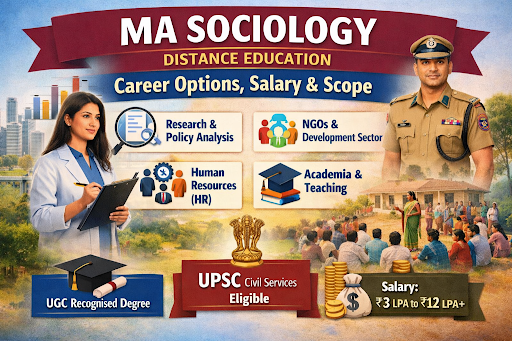
Pursuing that qualification through distance education removes the geographic, financial, and scheduling barriers that have historically kept postgraduate study out of reach for working adults, students in smaller cities, and those managing responsibilities that cannot be paused for two years of full-time campus attendance. An MA in Sociology through a UGC-recognised distance education framework delivers the same curriculum, the same academic credential, and access to the same career pathways, without requiring the student to restructure their life to access it.
This guide covers what the program teaches, where it leads, and what it is worth, in terms of both career and compensation.
Table of Contents
- Why Sociology at the Postgraduate Level Carries Genuine Professional Weight
- What the MA Sociology Program Teaches
- Where an MA in Sociology Takes You Professionally
- The Intersection With Social Work, and Why It Matters for Career Planning
- Salary and Compensation: What the Degree Earns Across Roles
- Why the Distance Format Works Particularly Well for This Discipline
- The Long-Term Scope of Sociology as a Professional Foundation
- Frequently Asked Questions
Why Sociology at the Postgraduate Level Carries Genuine Professional Weight
An undergraduate degree in any discipline provides exposure to a field. A postgraduate degree provides the depth, the analytical framework, and the research competency to work within that field at a level that commands professional recognition. For sociology specifically, the master’s level is where the discipline’s real practical applications become accessible.
At the postgraduate level, sociology moves beyond descriptive accounts of social phenomena into rigorous analytical territory: why systems of inequality persist, how institutions shape individual behaviour, what data reveals about social patterns, and how policy can be designed to produce specific social outcomes. These are the competencies that government bodies, research organisations, development agencies, and civil society institutions actively seek in the professionals they hire.
The distance education format, for students who already hold an undergraduate degree and want to build on it without interrupting their professional or personal circumstances, is the mechanism that makes this level of qualification accessible. It does not alter the academic content; it alters the conditions under which the student can access it.
Key Takeaway: A postgraduate qualification in sociology is not a stepping stone to academic teaching alone. It is the credential that makes a graduate eligible for analytical, research, policy, and community development roles that are inaccessible to those with undergraduate-level education only.
What the MA Sociology Program Teaches
The MA Sociology syllabus at most UGC-recognised universities is structured across four semesters and covers both foundational sociological theory and applied contemporary issues. The curriculum is built to develop two competencies simultaneously: the ability to think analytically about society using established theoretical frameworks, and the ability to conduct and interpret empirical research into social phenomena.
| Semester | Core Areas Covered |
|---|---|
| Semester I | Classical Sociological Theory (Marx, Weber, Durkheim), Social Structure, Research Methods |
| Semester II | Contemporary Theory, Sociology of Gender, Urban & Rural Sociology, Statistics for Social Research |
| Semester III | Sociology of Development, Political Sociology, Indian Social Structure, Specialisation Electives |
| Semester IV | Dissertation / Research Project, Applied Sociology, Social Policy & Welfare, Electives |
The research methodology component is particularly significant for career purposes. Graduates who can design surveys, conduct interviews, analyse qualitative data, and interpret statistical findings bring a skill set that is directly applicable across the research, evaluation, and policy domains where sociology graduates are most in demand.
Elective specialisations typically available in the third and fourth semesters include areas such as medical sociology, environmental sociology, criminology, sociology of education, and development studies, allowing students to align the latter part of their degree with the professional direction they intend to pursue.
Key Takeaway: The MA Sociology curriculum is not abstract academic theory. Its applied components, research methodology, policy analysis, and development studies are the building blocks of the professional roles that sociology graduates are hired to perform.
Where an MA in Sociology Takes You Professionally
The range of sociology jobs available to MA graduates is broader than most prospective students expect when they begin the program. The discipline’s core competencies, social analysis, research design, community understanding, policy interpretation, and communication across diverse groups, map onto a wide array of professional contexts.
| Career Path | Typical Roles | Sector |
|---|---|---|
| Research & Analysis | Social Researcher, Survey Analyst, Policy Analyst, Research Associate | Government, NGO, Think Tanks, Academia |
| Development Sector | Programme Officer, Field Coordinator, M&E Specialist, Project Manager | NGOs, International Agencies, Foundations |
| Education | College Lecturer, Academic Researcher, Curriculum Developer | Higher Education Institutions |
| Human Resources | HR Generalist, Diversity & Inclusion Specialist, Training Coordinator | Corporate, Public Sector |
| Public Administration | Civil Services (IAS/IPS/IFS), State Government Posts, Policy Officer | Government |
| Journalism & Media | Social Affairs Correspondent, Content Researcher, Fact-Checker | Media Houses, Digital Publications |
| Community Development | Community Organiser, Welfare Officer, District Programme Manager | Government, Civil Society |
The civil services pathway deserves particular emphasis. The UPSC Civil Services Examination accepts Sociology as an optional paper in the mains examination, and it is among the most popular optional subjects chosen by serious candidates. An MA in Sociology provides both the content knowledge and the analytical depth to approach the optional paper with genuine academic preparation rather than self-study alone.
Key Takeaway: Sociology graduates do not enter a narrow job market. They enter a wide professional landscape where the ability to understand, analyse, and communicate about human social behaviour is valued, in government, development, education, research, media, and corporate contexts.
Salary and Compensation: What the Degree Earns Across Roles
Salary for MA Sociology graduates varies significantly by sector, role type, and experience level. The development and non-profit sector, while offering lower starting compensation than the corporate sector, often provides faster access to substantive, senior responsibilities and mission-aligned work that many sociology graduates value alongside remuneration.
| Role / Level | Monthly Salary (Approx.) | Annual CTC (Approx.) |
|---|---|---|
| Research Associate / Field Researcher (0–2 years) | ₹18,000 – ₹30,000 | ₹2.2 – ₹3.6 LPA |
| Programme Officer / Development Sector (2–4 years) | ₹28,000 – ₹50,000 | ₹3.4 – ₹6 LPA |
| College Lecturer (UGC NET qualified) | ₹30,000 – ₹60,000 | ₹3.6 – ₹7.2 LPA |
| HR / Diversity Specialist – Corporate (3–5 years) | ₹40,000 – ₹75,000 | ₹4.8 – ₹9 LPA |
| Policy Analyst / Think Tank (4–6 years) | ₹45,000 – ₹90,000 | ₹5.4 – ₹10.8 LPA |
| Senior Programme Manager / NGO (6+ years) | ₹60,000 – ₹1,20,000 | ₹7.2 – ₹14.4 LPA |
| Civil Services (IAS/IPS – after selection) | As per the government pay scale + allowances | Varies by posting and level |
Compensation in the development sector is increasingly competitive as international funding agencies, large foundations, and government partnership programs have pushed salary standards upward, particularly for programme management and monitoring and evaluation roles at the mid to senior level.
Key Takeaway: Sociology is not a low-earning discipline for those who build strategic careers. The highest compensation in the field flows to those who combine academic credentials with applied experience, sector-specific expertise, and, in the case of government, competitive examination success.
Why the Distance Format Works Particularly Well for This Discipline
Sociology is, among postgraduate disciplines, exceptionally well-suited to distance learning delivery. Its core competency development, reading, analysis, argumentation, research design, and writing, does not require laboratory access, clinical placements, or equipment-dependent practical sessions. What it requires is sustained engagement with theoretical texts, research materials, and analytical challenges. All of these are fully achievable through structured self-study, digital resources, and periodic assessment.
For working professionals who want to pursue an MA in Sociology without pausing their careers, the distance format allows the program to run in parallel with employment. A field worker at an NGO, a government employee preparing for UPSC, or a graduate teacher looking to move into college lecturing can all pursue the qualification without requesting leave or taking a professional step backwards.
Students who benefit most from the MA Sociology through distance education:
- Working professionals in the development, social, or public sector seeking a formal postgraduate credential
- Graduates preparing for the UPSC Civil Services Examination with Sociology as an optional subject
- Teachers in schools or junior colleges seeking to qualify for higher education positions
- Graduates from adjacent disciplines (Political Science, History, Economics) seeking interdisciplinary depth
- Students in smaller cities or rural areas where postgraduate sociology programs are not available locally
Key Takeaway: The distance education format does not compromise the MA Sociology credential. It extends access to it, and for the working adults, UPSC aspirants, and geographically underserved students it serves, it is the format that makes the qualification achievable at all.
The Long-Term Scope of Sociology as a Professional Foundation
The scope of an MA in Sociology extends well beyond the first job it enables. As a discipline, sociology builds transferable analytical capabilities, the ability to interpret complex social data, understand institutional behaviour, design research, and communicate findings to diverse audiences, that remain valuable across a career that may span several decades and multiple role transitions.
The disciplines that intersect with sociology are expanding rather than contracting: public health sociology, urban planning, environmental justice, digital sociology, and data ethics are all emerging fields where sociological training provides a meaningful analytical foundation. Graduates who begin their careers in research or development roles frequently move into policy, consulting, leadership, or academic positions as their experience accumulates.
For those who pursue the academic route, the MA Sociology is the entry credential for UGC NET qualification, M.Phil., and doctoral research, a pathway that leads to faculty positions at colleges and universities across India, where the demand for qualified sociology teachers remains sustained.
Key Takeaway: Sociology as a professional discipline has a long-term scope that rewards continued learning and cross-domain engagement. The MA credential is not the ceiling of a sociology career; it is the foundation from which the most impactful ones are built.
Frequently Asked Questions
Is an MA in Sociology through distance education valid for government jobs and college teaching?
Yes, provided the degree is from a UGC-recognised university with approval to offer the program through distance mode. Government recruitment bodies and educational institutions recognise distance education degrees from approved institutions on the same basis as on-campus degrees. For college teaching positions, the MA Sociology combined with UGC NET qualification is the standard eligibility requirement, and the mode of the master’s degree, distance or campus, does not affect eligibility for the NET examination.
The Intersection With Social Work, and Why It Matters for Career Planning
An MA in Sociology frequently opens pathways that overlap with the domain of social work careers, though the two disciplines are distinct. Sociology is primarily analytical and research-oriented; it studies society. Social work is primarily interventionist; it works to change specific social conditions for individuals and communities. In practice, however, many roles in the development and welfare sector draw from both disciplines, and sociology graduates are regularly competitive for positions that also attract social work graduates.
Roles in community development, welfare programme implementation, grassroots project coordination, social audit, and NGO programme management all draw on the analytical and research capabilities that an MA in Sociology develops. The sociological understanding of how communities function, how social structures create barriers to welfare access, and how policy interventions produce intended and unintended outcomes is directly applicable to field-level work in these domains.
For graduates who want to work directly with communities, with marginalised populations, or in implementation rather than research roles, complementing the MA Sociology Distance Education credential with a certificate or diploma in social work or development practice can significantly strengthen their profile for these positions. The two credentials are more complementary than competing.
Key Takeaway: The MA in Sociology positions graduates at the analytical end of the social sector spectrum. Those who want to move into direct implementation roles should treat the degree as a strong foundation and supplement it with applied field experience or a complementary social work qualification.