

The irony is that mathematics, at the postgraduate level, has never been more practically powerful than it is right now. The systems that run modern economies, machine learning models, risk pricing algorithms, logistics optimisation engines, cryptographic protocols, and pharmaceutical trial designs are built on the exact foundations that a rigorous mathematics postgraduate programme develops. The problem is not the discipline. It is the story being told about it.
This blog is for the student who loves the subject, wants to build something meaningful with it, and deserves an honest account of what the postgraduate path in mathematics can actually open up, especially as more students discover that this programme can now be pursued without leaving employment or relocating.
Table of Contents
- Why 2026 Is a Particularly Good Moment to Be a Mathematics Postgraduate
- The Decision Most Mathematics Students Are Actually Navigating
- Who Should Pursue This Path and With What Expectations
- What the Programme Builds and Where It Leads
- The Career and Salary Landscape: An Honest Assessment
- Where Mathematical Talent Will Be Sought in the Years Ahead
- Key Takeaways
- Frequently Asked Questions
Why 2026 Is a Particularly Good Moment to Be a Mathematics Postgraduate
Something structural is happening in the job market that mathematics graduates are unusually well-positioned for, and it is worth naming precisely. The proliferation of AI and data-intensive systems has created an enormous demand for people who can do something that most software professionals cannot: understand why a model behaves the way it does. Building a neural network using a library is a skill a computer science graduate acquires in a course. Understanding the convergence properties of the optimisation algorithm beneath it, identifying when the loss landscape is leading the training astray, or designing a statistically valid evaluation framework for its outputs, these require the kind of mathematical depth that only a serious postgraduate programme builds.
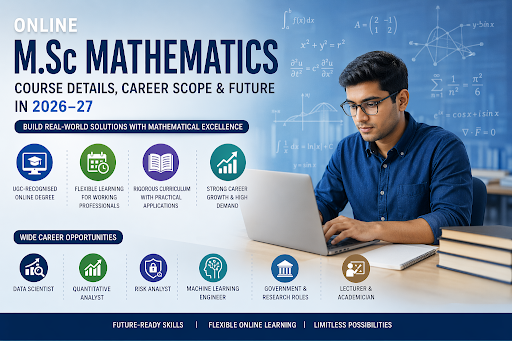
The MSc Mathematics career scope has expanded significantly because of this dynamic. It is no longer a choice between academia and teaching. It now spans data science, quantitative finance, cryptography and cybersecurity, actuarial science, operations research, pharmaceutical statistics, and AI research alongside the traditional pathways of education, government research, and competitive examinations. The graduates navigating this landscape most successfully are those who understood early that their mathematical training was not a single-purpose tool but a foundation that could be pointed in multiple directions.
💡 Contrarian Insight
In a market flooded with data science bootcamp graduates and self-taught coders, a
student with a rigorous postgraduate mathematics degree has a structural advantage
that is genuinely difficult to replicate. Employers in quantitative roles have
learned, often through costly experience, that surface-level technical familiarity
without mathematical depth produces professionals who can execute known solutions
but cannot navigate novel problems. The mathematically trained candidate can
navigate both.
Who Should Pursue This Path and With What Expectations
This direction makes strong sense if:
- You have a genuine affinity for abstract reasoning and mathematical rigour. The postgraduate programme demands intellectual engagement, not just competent execution
- You are targeting data science, quantitative finance, actuarial science, operations research, or AI research roles where mathematical depth is a direct professional differentiator
- You are preparing for competitive examinations, IIT JAM, GATE, CSIR-UGC-NET, or civil services, where the postgraduate curriculum overlaps directly with examination content
- You are a working professional or teacher who wants to formalise a qualification without pausing employment. The online format makes this structurally viable
- You are interested in academia and want to build toward a doctoral programme or faculty career in a discipline with real demand in Indian higher education
Recalibrate expectations if:
- You are choosing the discipline primarily for the credential rather than a genuine interest in the subject. The rigour of the curriculum is not forgiving of disengagement, and the job market for mathematics postgraduates rewards demonstrable depth over the mere possession of a degree
- You expect immediate high-compensation outcomes without understanding that the highest-earning trajectories in this field, quantitative finance, AI research, and senior data science, typically require two to four years of post-degree experience and often a doctoral qualification
- You have not thought about which application domain you want to move into. The degree is a foundation, not a direction, and the students who build the strongest careers are those who pair the mathematical training with domain-specific knowledge
What happens when this decision is made without that clarity: mathematics postgraduates who graduate without a working professional hypothesis often find themselves in a holding pattern, qualified for many things in principle, positioned for few things in practice. The ones who arrive with a hypothesis, even a tentative one, consistently find the transition faster and the early career more purposeful.
What the Programme Builds and Where It Leads
The MSc Mathematics subjects that form the architecture of a well-designed postgraduate programme divide into foundational and applied streams. The foundational stream includes Real Analysis (rigorous treatment of limits, continuity, differentiation, and integration), Abstract Algebra (group theory, ring theory, field extensions), Linear Algebra at depth (vector spaces, linear transformations, eigenvalue theory), Complex Analysis, Topology, and Differential Equations (ordinary and partial). The applied stream includes Numerical Methods, Probability Theory and Mathematical Statistics, Operations Research and Optimisation, Mathematical Modelling, Discrete Mathematics, and in many programmes, introductory courses in Mathematical Computing and Data Analysis. Together, these subjects build not just technical knowledge but mathematical maturity, the ability to reason precisely about abstract structures, which is the core competency that makes mathematics graduates valuable across such a wide range of applications.
The learning-to-career translation, made concrete:
- Real Analysis, Linear Algebra, and Probability → theoretical foundation for machine learning, statistical modelling, and AI research roles
- Numerical Methods and Mathematical Computing → scientific computing, simulation engineering, and computational finance roles
- Operations Research and Optimisation → supply chain analytics, logistics, resource allocation, and consulting roles
- Mathematical Statistics → biostatistics, pharmaceutical research, actuarial work, and data analytics
- Abstract Algebra and Discrete Mathematics → cryptography, cybersecurity, and algorithm design
The Career and Salary Landscape: An Honest Assessment
Data Science: The High-Demand Intersection
The alignment between MSc Maths for Data Science is one of the discipline's most
significant contemporary advantages and is worth examining in specific terms. Data
science, at its surface layer, running models, cleaning datasets, and producing
visualisations, is accessible to anyone with a few months of training. Data science at
the layer that actually creates business value, designing experiments, building models
that generalise reliably, interpreting why a model is failing, and communicating
uncertainty in ways that inform real decisions, requires exactly the mathematical
foundations that the postgraduate programme builds. Employers at technology companies,
fintech firms, healthcare analytics organisations, and quantitative research houses have
become considerably more sophisticated about this distinction. The mathematics
postgraduate is frequently the candidate they are actually looking for when they post a
data science role.
Career Paths Across Sectors
The question of career after MSc Mathematics is best answered by sector, because the
range is genuinely wider than most students appreciate before they begin the programme.
In technology: data scientist, machine learning engineer, quantitative analyst,
algorithm designer, research scientist. In finance: quantitative analyst (quant), risk
analyst, actuary, investment analyst, financial modeller. In the government and public
sector: statistical officer, research analyst at DRDO, ISRO, CSIR, or planning bodies,
and competitive examination pathways into the IAS, IFS, and state services. In
education: lecturer and assistant professor positions after UGC-NET or GATE
qualification. In consulting: operations research analyst, management consultant with
quantitative specialisation. In healthcare and pharma: biostatistician, clinical trial
analyst, health economist. The pattern across all of these: the discipline's value is
highest at the intersection with a second domain, and students who identify and build
that second domain early find the most compelling career positioning.
What Compensation Actually Looks Like
Discussing MSc Mathematics salary in India requires the same sector-specific honesty
applied in other disciplines. In government and academic roles, structured pay scales
apply to entry-level positions for statistical officers and junior research fellows,
typically ranging from Rs 35,000 to Rs 56,000 per month, with significant progression
through seniority and examination advancement. In the private technology sector, data
analyst and data science roles for mathematics postgraduates at established companies
range from Rs 45,000 to Rs 90,000 per month at entry level, with senior and specialist
roles in quantitative finance and ML engineering reaching Rs 1,50,000 to Rs 3,00,000 per
month at established organisations. Actuarial roles, which require additional
professional examinations beyond the degree, carry among the highest compensation in the
financial services sector at senior levels. The entry point matters less than the
five-year trajectory for students who choose their application domain deliberately and
build sector-specific depth alongside the mathematical foundation.
The Online Route Validity and Fit
An Online M.Sc Mathematics
from a UGC-recognised institution carries full credential
validity it is accepted for government employment, competitive examinations, UGC-NET
eligibility, and doctoral programme admission at the same standard as a campus degree.
The Distance Education Bureau approval of the specific programme is the key verification
point, and students should confirm this directly before enrolling. The format is
particularly well-suited to students who are managing employment alongside their
studies, those in locations without strong campus options, and those who bring the
self-direction that online learning requires. The subject matter of mathematics has an
interesting relationship with online delivery: the core of the discipline is
problem-solving and proof construction, which are practices that a motivated student can
engage with deeply through structured online coursework, provided the programme includes
regular assessment, faculty access, and applied problem sets rather than passive content
consumption alone.
Where Mathematical Talent Will Be Sought in the Years Ahead
The demand trajectory for mathematics postgraduates is shaped by three developments that are already visible and will intensify through 2027 and beyond.
The first is the maturation of India's AI and deep technology sector. As Indian technology companies move from building applications on top of existing AI infrastructure to developing foundational models and novel algorithms, the demand for professionals with genuine mathematical depth in optimisation, probability, and linear algebra will grow faster than the supply of adequately trained graduates. The students investing in postgraduate mathematics now are positioning for a market that will be considerably larger when they are five years into their careers.
The second is the expansion of quantitative finance in India. As capital markets deepen, derivative products become more complex, and risk management frameworks become more sophisticated, the demand for professionals who can build and validate quantitative models is growing at both private sector financial institutions and regulatory bodies. The combination of a strong mathematics postgraduate foundation with financial domain knowledge is one of the most highly compensated profiles in the Indian job market at senior levels.
The third is the sustained demand from India's higher education expansion. With hundreds of new colleges and universities requiring qualified faculty, and with the UGC-NET qualification serving as the gateway to those positions, the academic pathway for mathematics postgraduates remains one of the most stable and socially meaningful available. For students who love both the subject and its transmission, this trajectory combines intellectual engagement with genuine professional security.
Key Takeaways
- The student who has followed this to the end and is asking whether a postgraduate degree in mathematics is a sound investment for 2026 and beyond deserves a clear answer: yes, provided it is pursued with genuine engagement and pointed toward a specific application domain.
- Mathematical depth is a structural differentiator in data science, quantitative finance, AI research, and operations research, not a theoretical advantage but a practical one that employers have learned to recognise and pay for
- The programme builds rigour, not just content, the ability to reason precisely about abstract problems, which transfers across domains in ways that narrower technical training cannot
- The online format carries full credential validity from recognised institutions and suits working professionals and students without local campus options
- The salary trajectory rewards students who identify their application domain early and build sector knowledge alongside the mathematical foundation
- Government, academic, and research pathways remain strong and are supplemented by a growing private sector appetite for genuine mathematical talent
- The students who build the most compelling careers from this foundation are those who treat the degree as a beginning, not a destination and pair it with deliberate professional development in their chosen sector
Mathematics, pursued seriously, is one of the most durable investments in professional capability that a student can make. The applications change. The demand for rigorous quantitative thinking does not. The student who builds that capability now through a programme that takes it seriously will find that it compounds in ways that most other educational investments do not.