

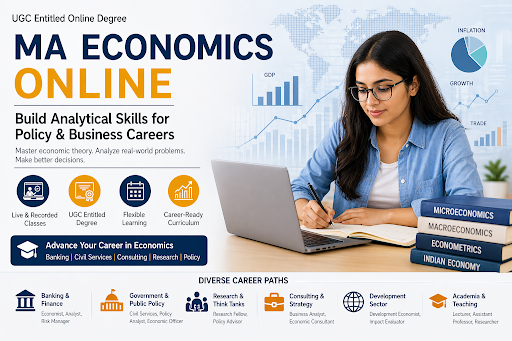
There is a reason economics graduates end up in so many different places. In government ministries, designing tax policy. In investment banks, modelling sovereign debt risk. In management consulting firms, advising on market entry strategy. In international development organisations, evaluating the economic impact of social programmes. In central banks, calibrating interest rate decisions. In startups, analysing unit economics and customer lifetime value. The discipline is not domain-specific. It is a way of thinking about incentives, about trade-offs, about the systemic consequences of individual decisions that applies wherever complex choices are being made.
The postgraduate degree is where that way of thinking is sharpened from undergraduate exposure into genuine analytical capability. It is where the models become rigorous, the mathematics becomes a tool rather than an obstacle, and the ability to take an economic question apart and reassemble it as a coherent argument becomes genuinely professional. For most students who pursue the MA in Economics seriously, it is less a qualification upgrade than an intellectual transformation, a shift in how they read the newspaper, interpret a policy announcement, evaluate a business case, or approach a dataset.
This blog is for the student or professional who is weighing whether to commit to this transformation, whether online, alongside a job, or with a specific career destination in view. It is an honest look at what the degree builds, where it takes people, and whether the investment makes sense for where you want to go.
⚡ Pattern Insight
In most cases, the economics graduates who build the strongest careers are not those who
mastered the most complex models. They are those who developed the discipline to think
slowly about fast problems to resist the first plausible explanation and look for the
better one, to trace consequences three steps further than the obvious conclusion. That
discipline is what the postgraduate curriculum builds, and it is what employers in
policy, finance, and strategy are consistently looking for and rarely finding fully
formed at the entry level.
The hidden implication: the most in-demand economic profiles in India right now are not
pure theorists or pure practitioners. They are professionals who can move between the
two, who understand the theoretical framework well enough to know when it applies and
when it does not, and who understand the practical context well enough to know what
question the framework should be answering. The MA in Economics builds this fluency
directly. It is not a credential for economic theory in isolation. It is a qualification
for economic reasoning in the real world.
Table of Contents
- What the Economy Is Asking For in 2026
- The Decision from the Inside
- Who Should Pursue This Degree & Who Should Think Carefully
- What the Degree Covers: Inside the Curriculum
- The Online Format: Access Without Compromise
- Where the Degree Takes You: Career Scope Across Sectors
- How the Career Builds: The Arc After the Degree
- Economics and UPSC: The Strongest Combination in the Optional Category
- Salary Realities: What the Market Pays
- Where Economics Careers Are Heading
- Key Takeaways
- FAQs
What the Economy Is Asking For in 2026
India's economy in 2026 is generating a specific and growing demand for analytical capability at every level of institutional decision-making. The government's push toward evidence-based policymaking requires economists who can evaluate data, model scenarios, and communicate findings to non-specialist audiences. The financial sector's increasing sophistication in credit, investment, and risk requires professionals who understand macroeconomic dynamics and their portfolio implications. The corporate sector's growing interest in competitive strategy and market analysis requires people who can apply economic frameworks to business decisions.
The common thread across all of these is not a specific technical skill it is analytical precision. The ability to frame a question correctly before attempting to answer it, to identify the relevant variables and discount the irrelevant ones, to evaluate evidence critically and construct an argument that holds under scrutiny. These are the capabilities that an MA in Economics builds and they are increasingly valued not just in traditionally economic roles, but across the full spectrum of data-dependent professional functions.
The Decision from the Inside
The students and professionals considering a postgraduate degree in economics tend to fall into recognisable groups. The first is the undergraduate economics student who found the discipline genuinely engaging and wants to go deeper before entering the job market, who senses that a year or two of postgraduate rigour will make them meaningfully more capable, not just more credentialled. The second is the working professional in banking, finance, government, or consulting who has reached a point where the theoretical gap in their education is becoming visible in the work they are being asked to do, and who wants to close it without leaving their role.
The third group is the civil services aspirant, the student who has identified economics as the optional subject for the UPSC Mains, and who recognises that studying the subject at the postgraduate level provides a depth of understanding that coaching institute modules cannot replicate. For all three groups, the online format offers the same core advantage: access to a rigorous, UGC-recognised postgraduate programme without geographic relocation or career interruption.
🔍 Contrarian Insight
One of the biggest gaps in how economics degrees are evaluated is the comparison
to MBA programmes. Many students believe an MBA provides the same analytical
development as an MA in Economics, with better placement outcomes. In practice,
the MA builds deeper theoretical rigour, stronger quantitative foundations, and
the specific analytical vocabulary that government, policy, and research roles
require. The MBA optimises for management generalism. The MA Economics optimises
for economic analytical depth. For students targeting policy, research, banking
regulation, or civil services, the MA is the more relevant qualification.
Choosing an MBA by default because the career path is more visible can mean
arriving at a role that demands economic depth with a credential that provides
management breadth.
Who Should Pursue This Degree & Who Should Think Carefully
Who is well-suited:
- Students with an undergraduate foundation in economics, mathematics, or statistics who want to build postgraduate analytical depth before entering policy, finance, research, or corporate strategy roles
- Working professionals in banking, finance, government, or consulting who are encountering the limits of their undergraduate economic knowledge in the work they are now being asked to do
- Civil services aspirants who have chosen economics as their UPSC optional and want the structured, rigorous exposure that postgraduate study provides rather than coaching-dependent preparation
- Graduates who want to pursue academic or research careers in economics, for whom the MA is the prerequisite for PhD candidature and academic positions
- Commerce and business graduates who want to add economic analytical depth to their existing financial or management knowledge
Who should think carefully:
- Students who are uncomfortable with mathematical reasoning in postgraduate economics require quantitative engagement that cannot be bypassed, and students who expect to avoid the mathematical dimensions of the curriculum consistently underperform
- Those who are choosing economics because they found undergraduate study easy, rather than because they want to go deeper into the postgraduate level, raise the rigour substantially, and the motivation needs to match
- Professionals who primarily need management skills rather than economic analytical depth, for those, an MBA or a management postgraduate programme is more directly aligned
What the Degree Covers: Inside the Curriculum
The MA economics subjects at the postgraduate level are designed to build rigour across four interconnected dimensions: the theoretical foundations of how economies work, the quantitative methods for analysing economic data, the applied domains where economic analysis is most consequential, and the research skills that allow economists to contribute independently to the discipline.
| Subject Area | Core Topics | Professional Application |
|---|---|---|
| Microeconomics | Consumer theory, producer theory, market structures, game theory, information asymmetry, and welfare economics | Market analysis, competition policy, regulatory economics, corporate strategy, pricing decisions |
| Macroeconomics | National income, growth theory, business cycles, monetary and fiscal policy, open economy macroeconomics, inflation | Policy analysis, central banking, government advisory, investment research, and country risk assessment |
| Econometrics and Statistical Methods | Regression analysis, time series econometrics, panel data methods, causal inference, R and STATA | Economic research, policy evaluation, financial modelling, and data analysis in any quantitative professional context |
| Public Economics | Taxation theory, public expenditure, fiscal federalism, cost-benefit analysis, public debt | Government policy roles, budget analysis, development economics, and multilateral organisations |
| Development Economics | Poverty and inequality measurement, human development, rural and agricultural economics, structural transformation | Development sector, international organisations, NGOs, government planning bodies |
| International Economics | Trade theory, balance of payments, exchange rate economics, international finance, WTO and trade policy | Export-import firms, central banking, international trade research, and foreign policy advisory |
| Financial Economics | Asset pricing, portfolio theory, derivatives, financial markets, corporate finance theory, risk and return | Banking, investment management, financial regulation, fintech, corporate treasury |
| Environmental and Resource Economics | Externalities, public goods, environmental policy instruments, natural resource valuation, climate economics | Environmental policy, regulatory bodies, sustainability consulting, green finance |
| Indian Economy | Structural features, sectoral analysis, economic reforms, planning and policy history, and current economic challenges | Civil services preparation, economic journalism, government advisory, and domestic policy research |
| Research Methodology | Scientific method in economics, research design, data collection, literature review, and dissertation writing | Academic research, policy research, programme evaluation, and evidence-based practice in any sector |
The breadth of the curriculum is deliberate. Economics at the postgraduate level is not a narrow technical subject; it is an analytical framework applied to the full complexity of human social organisation. The student who completes this curriculum exits with the ability to engage with economic questions across domains, from climate policy to financial market regulation to rural development, with the same rigorous analytical approach.
The Online Format: Access Without Compromise
The Online MA Economics from a UGC-recognised institution delivers the same academic curriculum as the campus programme through a combination of live faculty sessions, self-paced content modules, and continuous assessment structured around a semester calendar. The live sessions, typically scheduled for weekends or evenings, are where concepts are worked through, questions are answered, and the kind of intellectual dialogue that economics requires is facilitated. The self-paced content covers the foundational material. The assignments test application rather than recall.
For working professionals, the online format has a specific advantage that is rarely stated directly: it keeps them in the professional environments where economic concepts are being applied every day. A banker who studies macroeconomics while managing a loan portfolio has an immediate test bed for every concept. A government officer who studies public economics while preparing a budget note is not studying in the abstract. The learning is anchored in professional reality in a way that full-time campus study, removed from the professional world, cannot replicate. The format is not a concession to convenience. For this audience, it is often the pedagogically richer option.
Where the Degree Takes You: Career Scope Across Sectors
The MA Economics career scope is unusually wide for a single postgraduate qualification, because the analytical capability it builds is applicable across a range of sectors that may appear unconnected but share a common requirement: the ability to reason rigorously about complex systems.
| Career Domain | Specific Roles | Employers | Starting/Mid-Level Salary |
|---|---|---|---|
| Government and Civil Services | IAS/IPS/IFS, Economic Officer, Planning Analyst, Policy Advisor, Research Officer | Union and state government, NITI Aayog, RBI, finance ministry, planning departments | Rs. 6–20 LPA depending on grade and exam outcome |
| Banking and Financial Services | Economist, Credit Analyst, Research Analyst, Risk Analyst, Investment Analyst | RBI, SBI, commercial banks, NBFCs, investment banks, asset management companies | Rs. 5–14 LPA at entry; Rs. 12–25 LPA at mid-level |
| Research and Policy Institutions | Research Fellow, Policy Analyst, Programme Evaluator, Economic Advisor | Think tanks (NIPFP, ICRIER, NCAER), bilateral organisations, UN agencies, World Bank | Rs. 5–15 LPA; international organisations pay significantly higher |
| Management Consulting | Business Analyst, Strategy Consultant, Economic Consultant, Market Research Analyst | Big 4 firms, boutique economic consultancies, strategy arms of large corporates | Rs. 6–16 LPA |
| Corporate Strategy and Finance | Corporate Economist, Business Intelligence Analyst, Strategy Analyst, FP&A Analyst | Large Indian and multinational corporations, e-commerce companies, conglomerates | Rs. 6–14 LPA |
| International Development | Programme Economist, Development Researcher, Impact Evaluator, Country Economist | World Bank, IMF, ADB, UN agencies, and bilateral development organisations | Rs. 8–20 LPA+; international postings significantly higher |
| Academia and Research | Lecturer, Assistant Professor, Research Associate, Doctoral Student | Universities, colleges, and research institutions | Rs. 5–16 LPA (higher with NET/PhD and central university posting |
| EdTech and Financial Media | Economics Content Developer, Financial Journalist, Research Analyst | CNBC, Business Standard, edtech platforms, and financial data firms | Rs. 4–10 LPA |
💡 Decision Insight
The career table above reveals what most programme brochures understate: the MA
in Economics is not primarily a degree for people who want to become academic
economists. It is a qualification that opens analytical leadership roles across
government, finance, strategy, and development roles where the ability to think
economically about complex problems is the differentiating capability. The
student who understands this early and builds their internship, thesis, and
elective choices around a specific sector destination exits the programme with
both the credential and the domain-specific positioning that hiring managers are
looking for.
How the Career Builds: The Arc After the Degree
The career after an MA in Economics follows a pattern that is worth understanding before entry, because the initial role rarely reflects the full range of where the degree can take someone over a decade.
In the first two to three years, the MA Economics graduate typically enters as a research analyst, junior economist, credit analyst, or policy associate roles where the technical foundations of the degree are put to immediate use, often under senior supervision. These roles are important not just for the work they involve, but for the professional context they provide: the exposure to how economic analysis is applied in practice, how findings are communicated to decision-makers, and where the gap between theoretical models and institutional reality actually lies.
By the five to seven year mark, the professionals who have invested in their development, building sector expertise, developing communication skills, and taking on increasing analytical responsibility are typically in senior analyst, team lead, or associate director roles, with compensation and influence that reflect the scarcity of their capability profile. At this level, the combination of postgraduate economic rigour and accumulated professional experience is genuinely rare and genuinely valued.
Economics and UPSC: The Strongest Combination in the Optional Category
The case for MA Economics for UPSC preparation is one of the most compelling arguments for the degree in the Indian context, and it extends beyond examination strategy into the actual requirements of a career in the services.
Economics is consistently among the optional subjects with the strongest track records in the UPSC Civil Services Mains. The subject's analytical framework maps directly onto several General Studies papers, particularly GS Paper 3 on Economic Development, Poverty, and Agriculture. Students who have studied microeconomics, macroeconomics, public economics, development economics, and the Indian economy at the postgraduate level approach these papers with a conceptual depth and a vocabulary that coaching-dependent preparation simply cannot replicate. The MA Economics graduate who is also a serious UPSC aspirant is not studying two things in parallel. They are studying one thing at increasing depth.
Beyond the examination, the services themselves demand economic literacy. An IAS officer managing rural development programmes, a Foreign Service officer negotiating trade agreements, a Revenue Service officer designing tax policy, each of these roles draws directly on the analytical capabilities the degree builds. The qualification is not just good for passing the exam. It is excellent preparation for the job.
Salary Realities: What the Market Pays
The MA Economics salary in India varies significantly by sector and role, but the consistent pattern is that economic analytical capability commands a meaningful salary premium over generalist postgraduate profiles at every career stage.
| Role / Sector | Salary Range | What Elevates It |
|---|---|---|
| Research Analyst (Banking / Finance) | Rs. 5–10 LPA (entry); Rs. 12–20 LPA (mid-level) | CFA / FRM qualification, sector specialisation, firm type |
| Economist (RBI / Government) | Rs. 8–16 LPA (government scales + allowances) | Grade, exam performance, posting location |
| Civil Services (IAS/IPS/IFS) | Rs. 10–25 LPA equivalent (salary + benefits + scale progression) | Examination rank, posting, service seniority |
| Policy Analyst (Think Tank / Development) | Rs. 6–14 LPA; international orgs Rs. 12–25 LPA+ | Organisation type, publication record, international org affiliation |
| Management Consultant (Economic) | Rs. 8–18 LPA | Firm tier, client exposure, MBA add-on for senior roles |
| Corporate Economist / Strategy Analyst | Rs. 7–15 LPA | Industry sector, company scale, performance |
| College Lecturer / Assistant Professor | Rs. 6–16 LPA (NET / UGC scale) | NET qualification, institution type, PhD add-on |
| International Development Economist | Rs. 10–20 LPA+; international postings 2–3x | Organisation (World Bank / UN vs domestic NGO), seniority, technical specialisation |
The salary trajectory for economics postgraduates is steep for those who invest in specialisation, communication skills, and domain expertise in the first five years. The professionals who plateau tend to be those who stayed generalists who kept the analytical capability but never built the sector depth that makes them indispensable in a specific context. The degree provides the foundation. The career investment that follows determines the ceiling.
Where Economics Careers Are Heading
🔮 Future Projection
By 2027–28, three structural forces will expand the professional demand for
economics postgraduates in India significantly. First, the formalisation of
data-driven policymaking: as government departments and regulatory bodies invest
in analytics infrastructure, the demand for professionals who can interpret
economic data and translate it into policy recommendations will grow well beyond
the capacity of the existing talent pool. Second, the green transition: climate
economics, carbon markets, and sustainable finance are emerging as high-demand
specialisations where economic depth combined with environmental literacy is
extremely rare and correspondingly well-compensated. Third, India's increasing
integration into global financial and trade networks: as Indian firms
internationalise and foreign capital flows deepen, the demand for professionals
who understand international economics at a sophisticated level will grow
substantially. The MA Economics graduate who enters these currents early will be
positioned for some of the most consequential professional roles the Indian
economy will create in the next decade.
The academic track also deserves specific mention. India's universities are expanding their economics faculty, and the demand for NET-qualified postgraduates who can teach and research is growing faster than the supply. For those with a genuine passion for the subject and a long-term interest in academic life, the MA Economics is the necessary first step toward a career that combines intellectual independence with meaningful institutional contribution.
Key Takeaways
- The MA in Economics builds analytical precision, the ability to frame complex problems rigorously, evaluate evidence critically, and construct arguments that hold under scrutiny. This capability is valued across government, finance, strategy, research, and development.
- The degree is not primarily for aspiring academic economists. It opens significant career pathways in banking, civil services, consulting, corporate strategy, international development, and policy, each of which rewards economic analytical depth.
- The UPSC connection is strong and direct. Postgraduate economics study builds the depth that both the optional paper and the General Studies papers require, and the same knowledge base that performs in the examination is the knowledge base that performs in the service.
- The online format is particularly well-suited to working professionals because it keeps them in the professional environments where economic concepts are applied daily. The learning is anchored in reality in a way that full-time campus study cannot replicate.
- The salary ceiling for economics postgraduates is among the highest across social science postgraduate qualifications, particularly in banking, international development, and senior policy roles.
- The degree is most valuable for those who combine the academic qualification with deliberate sector positioning during and after the programme. The credential opens the door. The domain expertise that follows determines how far the door leads.