

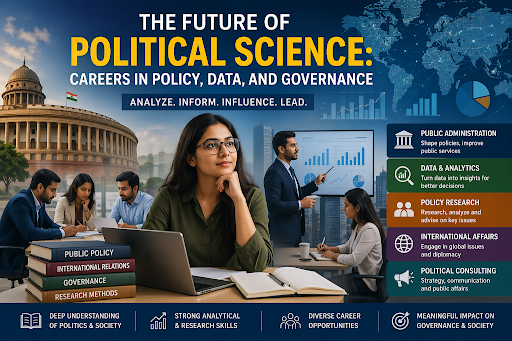
This is the moment that political science, as a discipline, was designed for. And yet the students who might benefit most from this shift are often the ones who have been told by well-meaning family, by uninformed career advisors, by the cultural weight of engineering and medicine as default ambitions that the humanities and social sciences lead nowhere professionally.
This blog is a direct correction to that assumption. It is written for the student who is drawn to questions of power, governance, and public life, and who deserves to see, with honesty and precision, what a postgraduate path in political science can actually build.
Table of Contents
- What Is Actually Changing in How Governance Works
- The Doubt That Follows Students Through This Decision
- Who This Path Is Built For: An Honest Map
- What the Discipline Actually Teaches and Why It Translates
- The Career and Salary Landscape: What the Evidence Shows
- What This Field Will Demand in the Years Ahead
- Key Takeaways
- Frequently Asked Questions
What Is Actually Changing in How Governance Works
Three forces are converging to reshape the demand for political science graduates in India, and they are worth understanding before the career conversation begins.
The first is the datafication of governance. State governments, central ministries, and regulatory bodies are increasingly investing in policy analytics, the systematic use of data to design, monitor, and evaluate public programmes. This creates demand for professionals who can combine political and social understanding with analytical capability. Pure data scientists without policy context produce recommendations that ignore implementation realities. Pure administrators without analytical grounding make decisions that data would have improved. The professionals who can work at that intersection are genuinely scarce.
The second is the formalisation of India's think tank and policy research ecosystem. Organisations such as NITI Aayog, the Centre for Policy Research, the Observer Research Foundation, the Indian Council for Research on International Economic Relations, and dozens of state-level policy institutes have expanded significantly in the last decade. They require researchers, analysts, and writers who understand Indian politics and governance at a structural level—not just as observers but as trained analysts.
The third is the growing sophistication of political campaigning, electoral strategy, and public affairs consulting. Parties, corporations, and civil society organisations are investing more in understanding political environments, mapping stakeholder dynamics, and communicating strategically across diverse constituencies. This has created a professional category of political analyst and public affairs consultant that barely existed in its current form twenty years ago and is now an established career track.
The Doubt That Follows Students Through This Decision
The hesitation that most political science students carry into their postgraduate decision is not about interest. Interest is rarely the problem; most of these students have been reading newspapers with genuine analytical attention since secondary school, following elections with the kind of structural curiosity that most people never develop, and thinking about questions of justice, power, and governance in ways that their peers who chose engineering programmes simply are not.
The hesitation is about the outcome. Whether the intellectual investment will convert into a livelihood. Whether the discipline is respected in the job market. Whether choosing this path is choosing to explain the choice for the rest of one's career.
These doubts are worth taking seriously, not to be dismissed with optimism, but to be answered with evidence.
🏛️ The UPSC Aspirant Path
Enrolled in a postgraduate political science programme with a specific strategy: use
the academic depth of the degree to strengthen the optional paper and the general
studies preparation simultaneously. Found that studying comparative politics, Indian
constitutional development, international relations theory, and public
administration in a structured academic environment produced a quality of conceptual
clarity that coaching institutes could not replicate.
🔍 The Policy Researcher Path
Had no interest in the civil services but was genuinely drawn to policy research,
understanding why programmes work or fail, what the evidence shows, and how to
communicate findings to people who make decisions. Joined a think tank as a junior
researcher after completing a postgraduate degree. Found that the training in
political theory, methodology, and Indian governance had made them useful in ways
that colleagues from other backgrounds were not.
📈 The Working Professional Path
Had been working in journalism, communications, or public administration for several
years without a formal postgraduate qualification. Found that a ceiling effect was
appearing—the roles that required deeper analytical credibility were going to those
with postgraduate training. Enrolled in a distance programme to complete the
qualification without pausing employment. The credential opened the next door.
Who This Path Is Built For: An Honest Map
This direction makes strong sense if:
- You are seriously preparing for the civil services examinations and want the academic depth that genuinely improves performance in the political science optional and general studies.
- You are drawn to policy research, public administration, electoral analysis, international affairs, or political consulting as a professional direction.
- You are in journalism, communications, or public affairs and want the formal postgraduate credential and conceptual framework to access more senior roles.
- You are a working professional whose current role intersects with governance, regulation, or public policy and who wants to formalise expertise.
Reconsider the framing if:
- You are approaching this as the path of least resistance rather than the path most aligned with your actual professional direction.
- You have not thought about which sector or role type you are building toward. Breadth is an advantage with direction and a liability without it.
- You are expecting the degree alone to produce career outcomes without complementary investment in exams, research, or skill building.
What the Discipline Actually Teaches and Why It Translates
A well-designed postgraduate political science programme does not produce people who can merely discuss politics. It produces people who can analyse political systems with methodological rigour, interpret policy environments with structural understanding, and communicate complex governance dynamics in ways that inform real decisions.
| Subject Area | Learning Outcome | Professional Translation |
|---|---|---|
| Political Theory & Constitution | Conceptual clarity on justice, rights, and power | Civil services, legal research, human rights advocacy |
| International Relations | Analysis of state behaviour and geopolitics | Diplomatic services, think tanks, global corporate affairs |
| Public Administration | Design and evaluation of government programmes | Policy analyst, programme evaluator, govt relations |
| Research Methods | Quantitative and qualitative political inquiry | Political consulting, electoral data analysis, academic research |
| Comparative Politics | Study of patterns across political systems | International development orgs, multilateral bodies |
The Career and Salary Landscape: What the Evidence Shows
Government Roles and the Civil Services
The most direct pathway for many political science postgraduates remains the civil
services. Government jobs after an MA in Political Science span considerably beyond the
IAS and IPS. State Public Service Commission positions, legislative research roles,
regulatory bodies (Election Commission, NHRC), and the Ministry of External Affairs all
constitute formal pathways.
Private Sector and Think Tank Roles
In the government sector, salaries follow pay commission scales. In the private sector
and think tank ecosystem, junior research positions typically begin in the range of
Rs 30,000 to Rs 50,000 per month. Senior research and policy advisory
roles reach Rs 80,000 to Rs 1,50,000 per month and beyond. Political
consulting and corporate govt relations tend toward the higher end.
The Distance and ODL Route
For students who cannot relocate, an ODL MA
Political
Science provides
access to the same qualification with full UGC recognition. This format is
particularly
well-suited to working professionals in journalism, public administration, or the
development sector.
What This Field Will Demand in the Years Ahead
- Multilateral Institutions: India's growing global role (G20, BRICS) is creating demand for analysts who understand international relations.
- Professional Campaigning: Data-driven electoral strategy and voter behaviour analysis are becoming standard practice.
- Political Risk Analysis: Corporations increasingly need professionals to assess regulatory environments and governance dynamics.
Key Takeaways
- The discipline is analytically foundational for careers in government, policy research, consulting, and journalism.
- UPSC alignment is structural—strengthening both the optional paper and analytical writing.
- Salary trajectories in private sector roles are competitive, with a strong five-year arc.
- Distance and ODL formats carry full UGC recognition for working professionals.
- Rewards those who bring both intellectual engagement and professional intentionality.